It's one thing to take a cookie sheet of already made newtons to a friend's house to stick it in her oven. It's quite another to make macaron batter, pipe it out, let it sit, bake it in multiple batches, then let it cool.
Sunday, October 10, 2010
Figs: Part Six ~ A Neighbor's Fig Tree ~
It's one thing to take a cookie sheet of already made newtons to a friend's house to stick it in her oven. It's quite another to make macaron batter, pipe it out, let it sit, bake it in multiple batches, then let it cool.
Wednesday, October 6, 2010
Figs: Part Five ~ Fig Newtons ~
Monday, October 4, 2010
Figs: Part Four ~ Fig Crostata ~
Figs: Part Three ~ Fresh Fig Tartlets with Creme Patisserie & Chocolate Crust ~
Basically, instead of plating the mousse dome and garnishing as was the original intent, I just dumped a bunch of diced figs on top of the creme patisserie and made fruit tartlets instead. Creme Patisserie is just the fancy name for pastry cream. They tasted great, but I was making sad faces the rest of the day. G had to keep telling me to stop being so sad but I couldn’t help it. Mousse that doesn’t set isn’t maddening or frustrating or anything other than just plain old sad...sad sad sad.
Figs: Part Two ~ Fig Mousse Cake and Toshi Yoroizuka ~
The recipe I attemped was from Toshi Yoroizuka, a famous pastry chef in Japan. He’s known as being the only Japanese person to have ever worked in a 3 star restaurant in Belgium. Whatever that really means. Regardless, his boutiques in Japan have hour long waits daily, and it’s pretty much impossible to get a seat inside the salon where he makes plated desserts in full view behind a counter. This was the second recipe of his that I attempted.
The plan was to make something that looked like this: http://grand-patissier.info/ToshiYoroizuka/recette/zoom141.htm
Granted I don’t have molds like his but below is how mine ended up. Unfortunately, with the melting going on, I only completed one of the cakes. I gave up on the other ones. I made them into tartlets instead. Fail.
In case you’re curious, the English translation of the recipe is below. Here’s the link to the original in Japanese: http://www.grand-patissier.info/ToshiYoroizuka/recette/recette141.htm
I halved everything since one thing I learned from that first recipe I attempted was that his recipes yield a LOT. I really should’ve just made a third of the recipe. I could probably even get away with making just a fourth since I only have eight molds of everything anyway, but first things first. I need to succeed at making the mousse set...bah.
Figs: Part One ~ Fig, Mascarpone, and Goat Cheese Tartlets ~
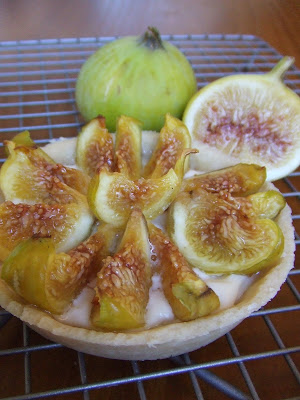
I thought making that tart but with fresh figs would be delicious. There were a lot of frangipane tart recipes using figs, but I’m not the biggest fan of that almond mixture, so I decided to experiment. As I was shopping for mascarpone cheese, I spotted some goat milk cream cheese and had to go for it. I’m not the biggest proponent of goat cheese but thought the tartness, offset a bit by the mascarpone cheese, would make for a creamy companion to the sweetness of the figs.
Let me tell you, I ended up right on that one! I also substituted lemons for the oranges in the original recipe, to decrease the sweetness of the dish. I blind baked the tart shells, was careful not to overfill it with the cheese mixture, and baked it until the filling was a bit set. Then I took them out and lined up the figs. One thing I learned from the grape/gooseberry experience was that the cheese mixture inflates and covers the fruit. I wanted the figs to stay visible so I thought this might work but it’s not like I had read it in a recipe so couldn’t be sure. It turned out how I wanted, although I can’t say for certain that had I not done that that I wouldn’t have achieved the same outcome. No matter, I can do another trial next time.
I should have made the tart shells a little thicker, and I still ended up overfilling some of them, but all in all they turned out pretty well. And it tasted just like I thought it would. Pat on the back for me. Win.
Saturday, October 2, 2010
Figs ~ an introduction ~
Mr. Fig and his family like dry, warm places. They don’t do well when it’s cold. Weaklings. Thankfully, they are cultivated 2-3 times a year, once in the spring from the previous season’s shoots, and the new (cough, better) stuff grows in late summer/early fall.
They’re very delicate and high maintenance though. That long standing family history makes them think they’re more important than other fruits. They have to be eaten quickly after being picked and don’t transport very well. These are not sturdy workhorses. But as much as they think so highly of themselves, I’ll let you in on a little known secret--those guys aren’t even real fruits! Those posers. Imposters I tell you. They’re actually the flower of the fig tree that is inverted into itself. As a flower, they’re duds.
Even so, they do deserve recognition for being the “fruit” that is mentioned the most in the bible. After eating the forbidden apple, Adam and Eve used fig leaves to cover their newly discovered parts. Romans cherished figs as well, especially considering that Romulus and Remus slept with their wolf mom under a fig tree.
All in all, their snobbery is a little justified. Plus, they’re high in fiber and potassium, and surprisingly have quite a bit of calcium in them. So read below to see what some of the major types are and maybe you’ll find one you like enough to make a member of your fruit family.
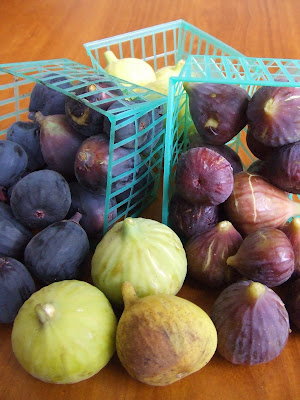
Adriatic: One of the more commonly seen light green or yellowish-green in color with pale pink or dark red flesh. Not as sweet as other varieties. They have an intense fig flavor when dried, but can also be eaten fresh.
Brown Turkey: These guys are probably the most commonly seen fresh figs out there. They’re medium sized with a purplish skin with a bright pink flesh. Turkey figs are my friends.
Calimyrna: They’re really called Smyrnas but those grown in the 31st state of the USA get a special name. The members of this side of the family are big, round, and have a thick, light green colored skin. The white and pink flesh inside isn’t as sweet as the rest of the clan, but when you get to know them a little better, letting them dry out, they turn soft and tender.
Celeste: small to medium, violet skin with extremely sweet, white flesh. Good fresh or dried. are about the size of an egg, a purplish-brown when ripe, and a dark, sweet, moist, purple flesh inside.
Kadota: Their claim to faim is that they’re used to make Fig Newtons. Now aren’t they special. Medium in size with a yellow-green skin, they aren’t as sweet as the Adriatic or Mission fig, but this American version of the
Italian Dottato fig has a bright pink center. awww.
Mission: They’re the smallest of the bunch, but with their dark purple colored exterior and their bright red flesh, they’re flavorful and spunky. They turn black when dried, so watch out. Their name comes from the Spanish missionaries who planted them up and down the California coast.
Foods to follow...