(J's Yellow Peach, Green Plum, and Blueberry Crostatas)
J asked if we could bake together over the weekend, and I of course said yes. How could I say no to some baking?
"What do you want to bake?" I asked.
15 minutes later, she ims her reply. It's a link to Ina Garten's Summer Fruit Crostata recipe.
Crostatas hm?
I’ve made tarts before, both big and small, and I’ve made pies, but I’d never thought to make a crostata, mostly because if I’m going through the trouble of making dough--I only own a dinky little mini food processor so always do it by hand which equates to “trouble”--I might as well shape it into a pan. But J said crostata, so crostatas it was. I guessed she’d make a big full sized one (turns out she made two!) so I attempted some individual sized ones for myself. That way I could play around with the filling--I’m an experimenter after all. A visit to the farmer’s market provided some inspiration. Heirloom tomatoes, mini squash and eggplant, and everywhere--literally at every stand--there were plump, juicy, ripe plums, peaches, and nectarines. Yum.
 Trusty as books like The Art and Soul of Baking are, I didn’t feel like using a recipe I’d used before so I did a bit of googling. I spotted the name “Michael Chiarello” and of course had to click on that link. His name is not one I knew of 8 months ago, and to this day I’ve still never had a chance to taste his food, but ever since my SF foodie friend told me about the wonders of Bottega in Napa, Michael Chiarello’s name always seems to catch my eye. The recipe looked good. Solid. Standard. In a good going-to-end-up-as-a-simple-but-delicious- staple kind of way. I probably wasn’t going to go wrong with an Italian chef’s recipe for an Italian dessert. Right?
I made the dough ahead of time, on Saturday, refrigerating 8 little discs of pate brisee. It was the usual process. Toss the dry ingredients together, cut in some cold unsalted butter, sprinkle a bit of ice water, and bring it all together. J came over around noon the next day, after a stop at the Hollywood Farmer’s Market, appearing with a bag of huge yellow peaches, some juicy little green plums just like the ones I got, and a big box of *cough cough* (expensive) blueberries. Sadly, that’s what happens when they’re not in season. But I’m glad she got them because they were plump, tasty, and made her crostatas colorful and gorgeous. I snagged some for my nectarine one so I really can’t fault her at all. Delish.

(One of the mini crostatas - Yellow Nectarines with blueberries swiped from J's stash)
Fruit (and butter and flour) in hand, J’s baking lesson by yours truly began. Armed with a printed copy of Ina Garten’s recipe, she measured out the dry ingredients while I stuck her box of butter back in the fridge saying we had to keep it cold. She asked why. I showed her how to cut the butter into the flour mixture using a pastry cutter. Hey, I asked if she wanted to attempt using my mini food processor. I did offer...Then she asked why one had to make sure the butter was cut into little pieces and mixed throughout the flour. I had no idea. I dropped some ice cubes in water so she could measure out three tablespoons to bring the dough together at the end. She asked why the water had to be cold. By now, I hope you realize I didn’t have the answer to that question either...
J, I now have answers for you! The butter and water have to be cold in order to keep the formation of gluten protein to a minimum. The opposite of tart crust would be bread. Bread uses warm water and a lot of kneading and a lot of hands on actions (aka warmth - since your hands are warm) to increase the formation of gluten protein. That’s what makes that yummy fluffy chewy bread texture. Crostata dough, whether it be a flaky pate brisee or a crispy pate sucre, wants to be the opposite of that. Hence cold everything, minimal handling.
Water is also something that increases gluten production. You add a bit of cold water at the end to bring the dough together, and that’s why it’s important to keep it cold. Water is also a key reason for keeping butter cold. Butter contains water. By keeping it cold, the little water droplets stay suspended within the little butter bits, keeping the water away from the gluten (aka flour). Water may increase gluten production but that can only happen if they two actually come into contact with each other!
And while water is initially the enemy, it becomes the hero once the dough hits the oven. That’s because the water evaporates during the baking process, leaving little air pockets behind. Those little pockets of air helps make everything flaky and crispy and delicious.
This evaporation is also the reason for tart/pie crusts shrinking when baking. Water evaporating leaves empty space, causing some shrinkage. But more importantly, heat from the oven facilitates the protein bonding process. When a gluten strand bonds with more gluten strands, they all bond together and link up, shrinking up to each other.
All this babbling is my long winded answer to why things must be kept cold.
Anyway, J and I finished up the dough and in between my meager attempts of teaching and imparting wisdom (which I really didn’t accomplish until typing all this out just now), I rolled out my own mini crostatas, slicing fruit and veggies, tossing them with some sugar or salt, and using up whatever cheeses I had in the fridge. While J’s dough chilled up, I baked off a couple rounds while she cut up her fruit.


(The sweet - Green Plum, Black Plum, and White Peach)


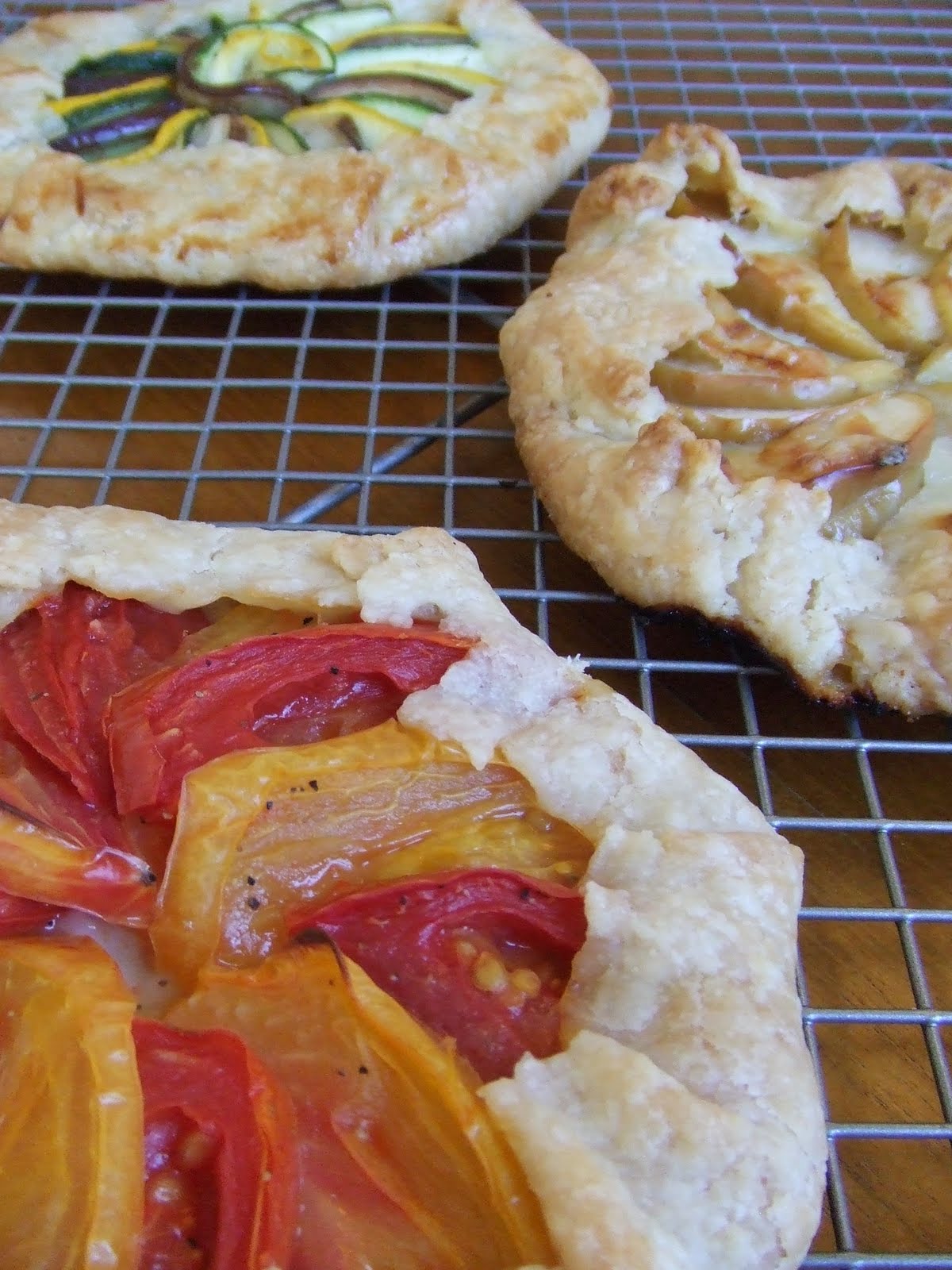
(The savory - Mini Zucchini, Mini Yellow Squash, and Mini Eggplant with lemon & olive oil; Heirloom Tomatoes; Gala Apple with White Cheddar Cheese)
An hour later, with the Law and Order SVU marathon on as background noise, I showed J how to roll out the dough. No floured boards for us. It may be modern and untraditional (or it may not be. who knows? we’ve already established I’m not the most knowledgable of bakers, but hey, that’s what this blog is for!) but it’s clean, easy, and makes it so much easier to stick the rolled out dough back in the fridge should it get too soft. The first one ended up being overstuffed and pudgy, in a good, bursting with flavor kind of way. The second still had plenty of fruit but was a bit less...zealous. Basically, it was beautiful!
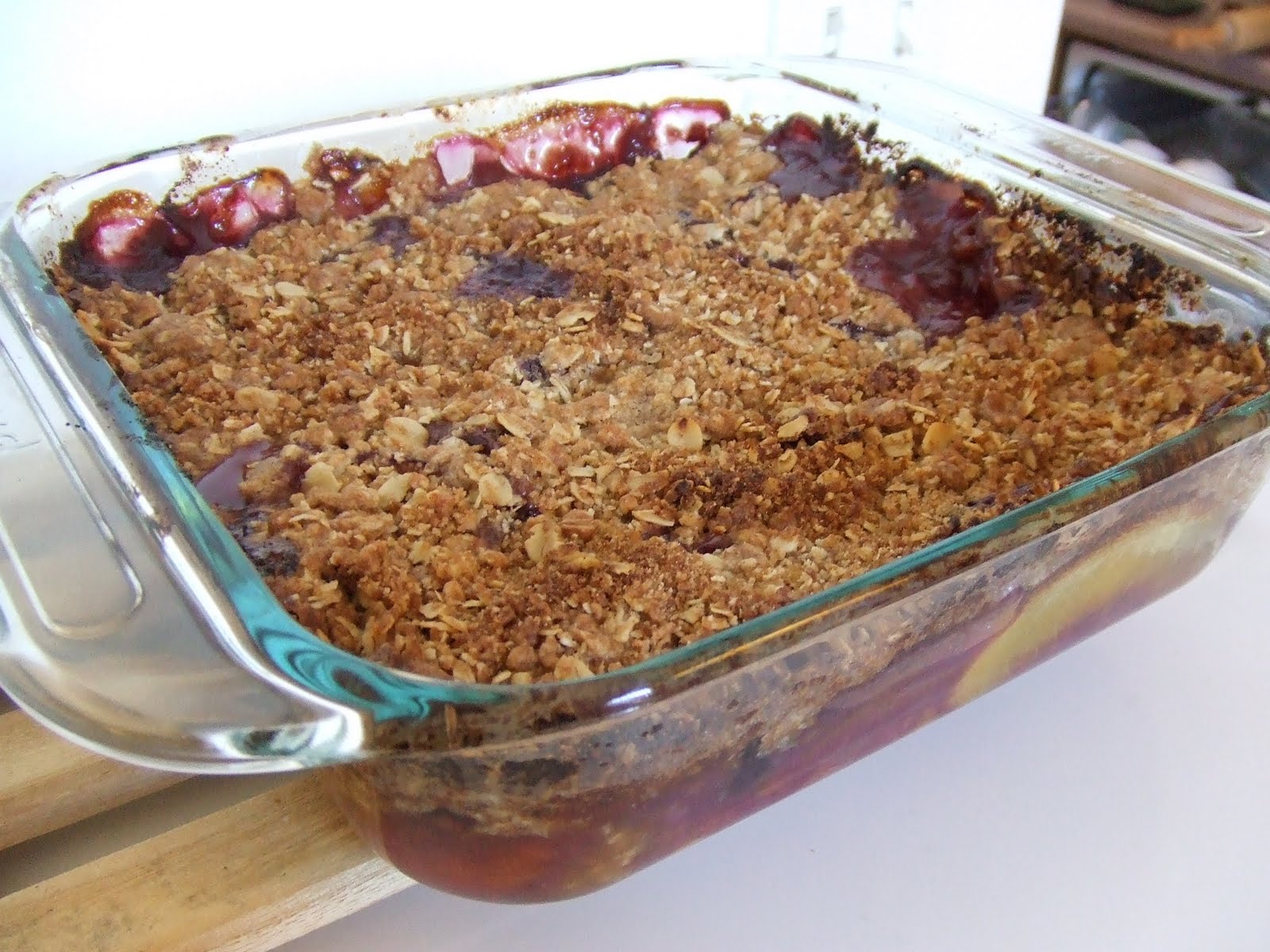
 And there ended up being a lot of extra fruit so after consulting The Art and Soul of Baking, I threw together 1/2 a cup of flour, 1/2 a cup of oats, 1/2 a cup of brown sugar, a dash of cinnamon and ground ginger, and cut in a stick of butter. We dumped the fruit into an 8 by 8 glass baking dish, poured on the crumble mixture, and stuck it in the oven with the second crostata. I left it in for another 20 minutes or so once we took out the crostata and it turned out perfectly crispy and crumbly. The oven temperature of the crostata wasn’t the same as the crumble’s recipe but no matter. It still worked. I like baked goods that require precision, but it’s fun to make improvised, thrown-together desserts too.
 Turns out one of J’s crostatas was for her friend’s birthday. She made a home delivery that night. I hope he enjoyed it--at the very least, it was made with lots of love by J. And I hope J’s co-workers are loving the crumble. I had to steal a piece before she took it home with her. I couldn’t resist... After cleaning up for the day, I had to ask myself what exactly the different is between a crostata and a galette. Or course that means I googled to find out. Everything I read basically says they’re the same thing, just that one is Italian and one is French. The Italian one is typically made with a pastafrolla dough, while the French one is a pate brisee dough, although I guess these rules are always bended with preference. Pastrafrolla seems to be what the French call Pate Sucre which basically means it has more sugar and eggs so it turns out crisper and less flaky. Free standing molded tarts often use Pate Sucre.
Also, I’m used to seeing fruit crostatas or savory crostatas the most, but I believe the jam crostata, or crostata di marmellata, is very popular in Italy. The crostata di frutta also seems popular, but that doesn’t seem as free form. Since it’s basically a crust with crema pasticcera (creme patisserie, or pastry cream) with fresh fruit on top covered by a glaze, it seems more like a fresh fruit tart, but please correct me if I’m wrong. All of this makes me think that in Italian, a crostata doesn’t necessarily directly refer to a free form tart but to tarts in general, both in and out of a tart pan. Thoughts from any and all Italian friends on this topic is greatly appreciated.
As for the French galette--while it most often refers to the free form rustic tart dish, there seem to be a lot of regional variations as well. Some regions call buckwheat crepes filled with savory toppings galettes, and the famous Galette de Rois, or King’s Cake--eaten on January 6th for the feast of the Epiphany--in the Normandy region it’s a puff pastry dish filled with an almond frangipane filling (as opposed to the bread-y, frosted New Orleans version).
All in all, that just means that one post for the crostata/galette isn’t going to be enough and I need to get a bakin’ to tackle all of this buttery goodness.  J, thanks for a fun day.